

Beach Tips for Lipedema Legs: How I Use Water, Movement and Rest in Summer

A practical guide from lived experience on how gentle water movement can support lipedema legs during hot summer days.
Summer can be beautiful.
The sea, the sun, the feeling of freedom, the possibility to spend more time outside.
But for women living with lipedema, summer can also bring specific challenges. Heat can make the legs feel heavier, more swollen, more sensitive and more uncomfortable. Compression can feel harder to wear. Movement can feel more difficult. Even a simple beach day can require more planning than people imagine.
After three lipedema surgeries on my legs, I still manage my lipedema every day.
Surgery changed many things for me, but it did not mean that I could stop taking care of my body. Lipedema is a chronic condition, and for me, long-term management means learning what supports my legs in different seasons, situations and environments.
In summer, one of the things that helps me the most is water.
Not as a miracle solution. Not as a medical treatment. But as a gentle and practical support for my legs.
When I am at the sea, I use water, movement and rest as part of my daily lipedema routine.
Why water can feel good for lipedema legs
For me, being in the water gives my legs a feeling of relief.
My body feels lighter. Movement feels easier. The pressure on my legs feels different. I can move more gently without forcing my body.
This is one of the reasons I like walking in the sea or doing small movements in the water. It allows me to stay active without turning movement into pressure or punishment.
With lipedema, especially in summer, I do not believe in pushing the body aggressively. I believe in choosing movement that supports the body.
Water allows me to do exactly that.
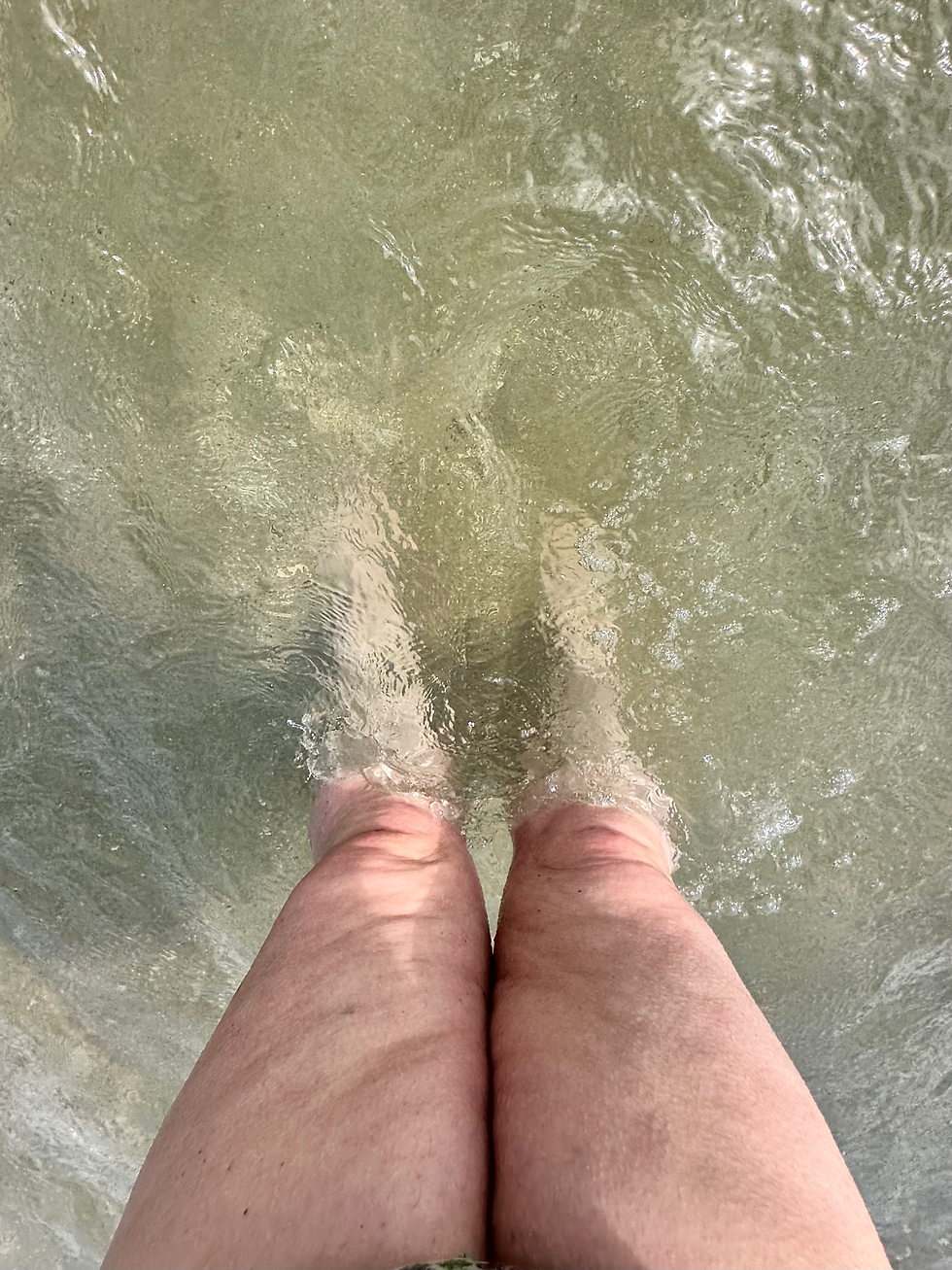
1. I do not stay only on the sunbed
When it is very hot, staying still for too long does not feel good for my legs.
Of course, rest is important. But for me, beach days work better when I alternate between rest and gentle movement.
I may rest on the sunbed, but I also go into the water several times. I do not wait until my legs feel too heavy or uncomfortable. I try to use the water before the discomfort becomes too much.
My approach is simple:
rest,
water,
gentle movement,
shade,
hydration,
repeat.
This helps me enjoy the beach without completely ignoring what my legs need.
2. I walk slowly inside the water
One of the easiest things I do is walking slowly in the sea.
I do not turn it into a workout. I do not count steps obsessively. I simply walk.
Forward.
Backward.
Sideways if I feel like it.
Slowly and with control.
Walking in the water feels different from walking on land. The body feels supported, and the movement is gentler on the legs.
For women with lipedema, this can be a simple way to move during summer without putting too much pressure on the body.
3. I use small movements, not intense exercise
At the beach, I do not need a complicated exercise routine.
Small movements are enough.
Some movements I like in the water are:
ankle circles,
gentle heel raises,
slow leg lifts,
walking forward and backward,
small knee bends,
gentle side steps.
The goal is not to burn calories.
The goal is not to exhaust the body.
The goal is to support circulation, mobility and body awareness in a way that feels manageable.
With lipedema, especially in the heat, I prefer movement that helps me feel better afterwards, not movement that leaves me drained.
4. I start small
You do not need to stay in the water for one hour to feel a benefit.
Sometimes 10 or 15 minutes are enough.
For me, it is often better to go into the water several times during the day rather than doing one long session and becoming tired.
Short and repeated moments can be more realistic.
Especially if:
it is very hot,
you are post-op,
you are tired,
you are not used to moving much,
your legs feel very heavy, or
your body is asking for a slower pace.
This is also something I often remind women in mentoring: consistency does not always mean doing more. Sometimes it means doing less, but doing it regularly and with more awareness.
5. I rest after movement
Water helps me, but rest also matters.
After walking or moving in the water, I try to rest in the shade, drink water and avoid staying too long in direct heat.
For lipedema legs, recovery after movement is also part of the routine.
It is not only about what you do in the water. It is also about how you support your body afterwards.
For me, a good summer routine includes:
gentle movement,
hydration,
shade,
rest,
comfortable clothing, and
listening to my body.
6. I listen to my body instead of forcing it
This is one of the most important points.
With lipedema, movement should support the body, not punish it.
If I feel dizzy, too tired, overheated, uncomfortable or in pain, I slow down.
I do not believe in forcing the body just because “movement is good”. Movement is only helpful when it is adapted to the person, the moment and the condition of the body.
This matters even more before and after lipedema surgery.
The body needs preparation.
The body needs recovery.
The body needs structure.
But it also needs respect.
Why this matters before and after lipedema surgery
Many women think about lipedema surgery as one specific date.
The operation day.
But in reality, the body needs support before and after that day.
Before surgery, it is important to understand your body, your routines, your movement, your nutrition, your compression, your lymphatic care and your recovery plan.
After surgery, it is important to protect your results, support healing, monitor your symptoms and slowly rebuild your daily structure.
This is why I created my 90+90 Days Mentoring Program.
90 days before surgery to help you prepare with more clarity.
90 days after surgery to support your recovery and help you preserve your results long-term.
Because living with lipedema is not only about surgery.
It is about learning how to organise your life with lipedema before surgery, after surgery and in everyday life.
Final thoughts
Being at the beach after three lipedema surgeries means a lot to me.
I can enjoy the sea.
I can move in the water.
I can feel lighter.
I can live beautiful moments with my body.
But I also know that this does not happen by chance.
It comes with care.
With structure.
With listening.
With long-term management.
Lipedema is lifelong, but it does not mean life has to stop.
For me, water is one of the simple ways I support my legs in summer.
And sometimes, simple things repeated with awareness can make a real difference.
Are you new to lipedema, and you do not know where to start?
Are you preparing for lipedema surgery and feeling overwhelmed by everything you need to organise?
My 90+90 Days Mentoring Program starts in September.
Together, we work on preparation before surgery and support after surgery so that you can move through your lipedema journey with more clarity, structure and support.
Applications for September are open.


Comments